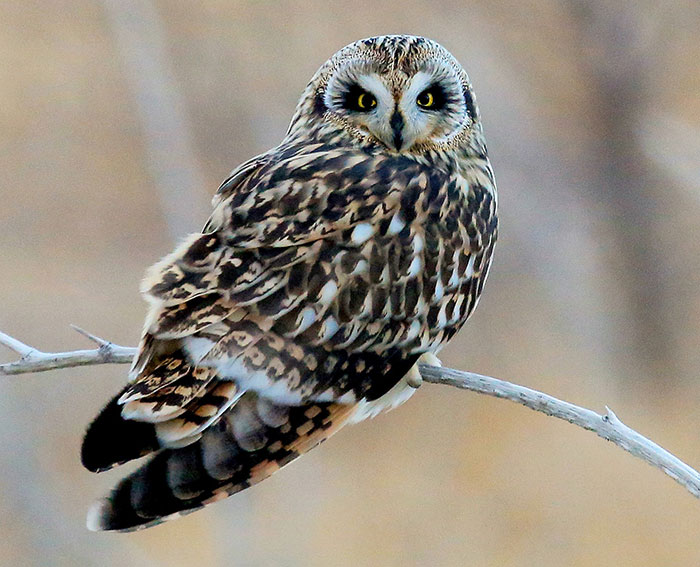
Short-Eared Owl
Image © Tim Lenz; Cornell Lab of Ornithology | Macauley Library
The Short-Eared Owl, Asio flammeus, is one of the thirty-five at-risk species that resides within the Limestone Landscapes of the Great Northern Peninsula. Aptly named, this medium-large predatory bird lacks conspicuous ear tufts and, unlike many other owls in NL, can be found hunting and nesting in more open meadows, tundra, and coastline (Godfrey 1976, Warkentin and Newton 2009). The plumage is a mix of tawny and darker brown intermixed with white and distinctive dark vertical banding on their abdomen (Godfrey 1976, Burrows 2002). During breeding and nesting, these birds will form a small depression in barren ground, grass and other vegetation, which is difficult to see from a short distance (Godfrey 1976). Breeding and nesting sites have been observed throughout insular Newfoundland, with several confirmed nesting sites observed along the Great Northern Peninsula (NL Breeding Bird Atlas). This amazing and efficient predator of small rodents is active during both day and night and, if you are lucky, you might catch its acrobatic hunting and dramatic courtship maneuvers.
Populations of the Short-Eared Owl are closely linked to their rodent prey, with decreases observed when the abundance of prey is very low. Since the 1970s, the number of Short-Eared Owl in Canada decreased by approximately 70% and, in Newfoundland and Labrador, the population has been designated as Threatened (COSEWIC 2021, Endangered Species Act O.C. 2002-274). Habitat degradation and loss through direct human interference and climate driven changes in the landscape are impacting nesting and the ability to catch prey, which makes the recovery of this species challenging.
-
Scientific Name
Asio flammeus
-
Common Name
Short-Eared Owl
-
Species Status Listing
Threatened