Community Based Stewardship Actions
Through direct engagement with communities, partners of the Limestone Landscape Priority Place Project have been spreading awareness and education of the important ecosystems and species of the limestone landscapes of the Great Northern Peninsula.
Highlights from 2025
Canon Richards Field Trip to Sandy Cove Restoration Site
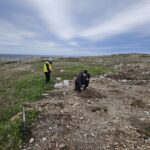
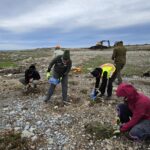
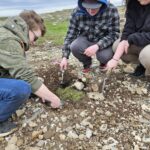
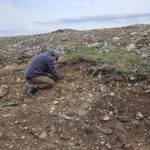
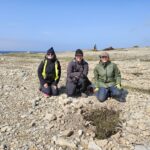
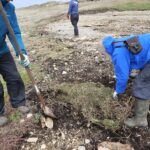
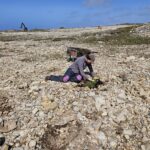
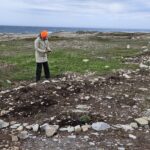
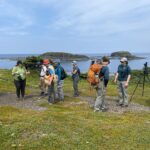
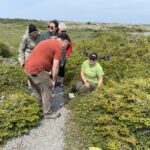
Biology students from Canon Richards Academy in Flower’s Cove attended a field visit day led by restoration experts. The students received a lesson on the importance of the site, why the restoration was taking place and how they were making a difference. They were able to do hands on work with ecologists and biologists from MUN, provincial government, and non-profits to re-plant native species and remove invasive species. To learn more about the Sandy Cove restoration visit the “Restoration” tab above.
Limestone Barrens Day (Port au Choix)
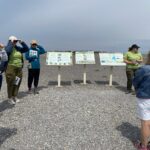
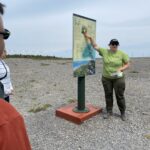
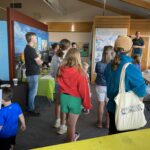
Through collaboration of the Parks Canada National Historic Site (Point Riche) and Western Field Unit, along with local non-profits Intervale Associates and Stewardship Association of Municipalities, local residents and tourists visiting the site were able to enjoy info sessions, info tables, face painting, airbrush tattoos of species, species based crafts and interpretive walks of the barrens led by Intervale. The day saw about 80 participants enjoy the various activities offered.
BioBlitz 2025 Community Events
Intervale Associates partnered with the NL Wildlife Division to host several events during the 2025 Bioblitz of the Limestone Landscapes organized by the NL Wildlife Division.
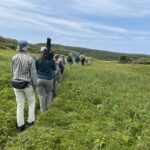
The first event was an interpretive walk through coastal meadows and bluffs in Ship Cove, led by Jessica Turner of Intervale Associates and assisted by various experts taking part in the Bioblitz. Participants saw rafts of sea ducks, impressive lichen species, flowering plants and mosses.
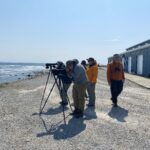
Intervale also led a shorebird workshop in Anchor Point, where participants were able to learn how to identify birds and were able to spot some migratory shore birds such as Ruddy Turnstone, Greater Yellowlegs, Black-bellied Plover and many more through binoculars and spotting scopes provided by Intervale.
Bringing back the Limestone Barrens at Sandy Cove and reclaiming our amazing unique plant biodiversity through restoration
WHY are we doing this?
The Limestone Barrens around Sandy Cove is home to a very rare tiny plant, Long’s braya (Braya longii) and many other unique Limestone Barrens plants (LB) – and when the quarrying started, its habitat and home was lost. Long’s braya is only found along a tiny stretch of about 6 km with Sandy Cove at its centre – that is the entire global distribution!
Quarrying started in 1968, and continued to provide gravel for the highway upgrade in the early 1970s and stopped in 1990s. The area would have been cleared of vegetation by pushing the top layer into large piles called “overburden” to access the gravel, removing the habitat for braya and other rare plants. Once the gravel was scooped up, it was crushed to the size needed for road building in a huge on-site crusher. The site was abandoned after the road was completed and left with a rusting 2-story crusher and lots of garbage. Luckily, Parks was able to obtain funds to clean the site up as it was a safety risk, and the crusher and garbage were removed prior to habitat restoration.
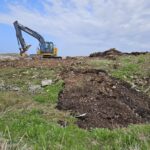
There was a small portion of Sandy Cove that was untouched by quarrying, and that area was established as the Sandy Cove Ecological Reserve to offer protection to the remaining LB. Unfortunately the quarried site wasn’t recolonized by native plants and the overburden piles were taken over by plants not found on the LB, many of them invasive weeds. That is because the piles are very high in nutrients that weeds love but the native plants cannot grow in because they get shaded out the weedy species. Therefore, the overburden piles had to be removed from the site to make it habitable by the limestone-loving native plants. The piles also contained a lot of buried garbage that was a hazard to anyone walking over the piles.
By restoring this area and replanting vegetation native to the area, including Long’s braya, we hope to ensure the long-term preservation of this amazing little plant that is so tied to this area. The goal is include this restoration site as a tourism stop of interest.
How did we restore the site?
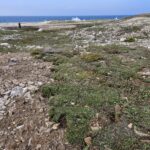
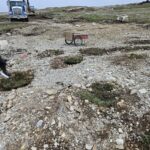
The restoration happening in two stages. The first stage of physical restoration started in September 2016. We knew from air photos what the site looked like prior to the quarrying and so we tried to recover the beach ridges to the original conformation but as much of the gravel had been removed, we smoothed the site out to mimic the ridges. Before the excavator started removing the overburden piles, we had to make sure we rescued any native plants that had started to colonize the area. Experts identified the plants and then with the help of local High School students, the plants were dug up, planted into pots and then buried on site for the winter. Some of the larger plants were planted back into the area right away. Once the plants of interest were rescued, the excavator carefully removed the overburden piles, and dump trucks took the material and all the weeds growing in it, off-site. The removal will be done by a local construction company who had experience doing this type of work. Once the overburden piles are removed, the area was flattened to look like original ridges (as much as possible given some of the gravel was removed). We also installed soil temperature dataloggers to track the movement of the soil to see if the freeze-thaw cycles returned, as the seeds need this movement to help them germinate. The following June the rescue plants were planted into the restored area.
Physical restoration is costly and it wasn’t until Sept 2024 that we were able to secure funding to continue the overburden removal. As we did with the first stage of restoration, the plants were rescued and overwintered in pots on the site prior to overburden removal. The rescued plants were replanted in June 2025 by volunteers and local High School students. The overburden piles in the final portion of the site were removed in June 2025 – the physical restoration of the site has been completed!
We also were able to recover mats of native vegetation from one of the overburden piles prior to their removal – and we call these “arc” islands because they are made up a many native plants and will be the start the process of the revegetating the barrens. These islands were planted across the newly restored area, and in 2026, we will check them to see how well the plants are growing. In addition, we also collected the seed of local plants (under all the necessary permits!). The seeds are part of a larger LB seed collection that are kept in proper conditions at the Memorial University Botanical Garden in St. John’s. In 2026, the seeds will be planted back onto the site to help recover the native plant diversity.
We hope that Long’s braya and all the native plants can once again live in the area and thrive!
WHO was involved?
The restoration is a partnership between Memorial University, NL Wildlife Division, NL Parks Division, Wilder Institute, Intervale Associates, and volunteers, including Canon Richards High School students.
The restoration was funded by Environment and Climate Change Canada through the Limestone Landscapes Priority Place and Wilder Institute https://wilderinstitute.org/.